
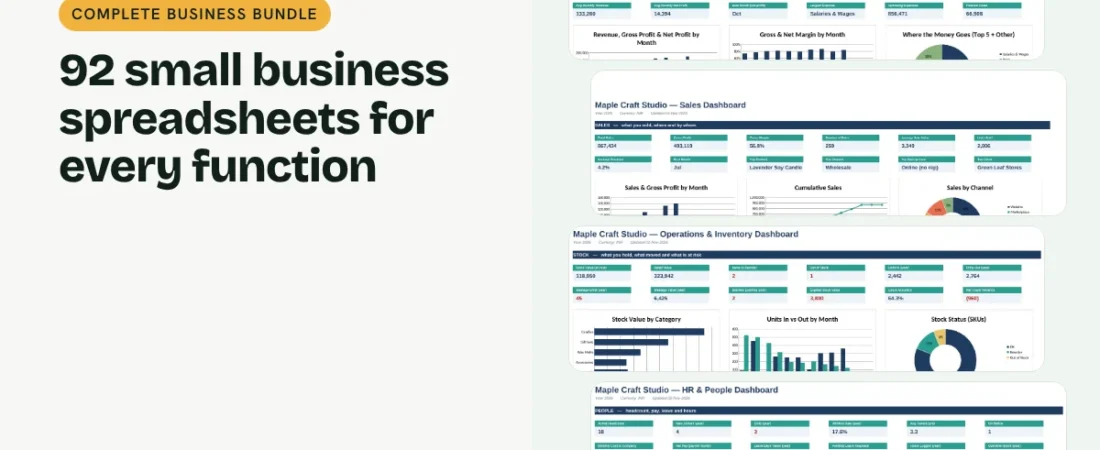
The right small business spreadsheets let you run every part of the business, from the books to the team, without buying nine different software subscriptions. This guide maps out 92 linked templates across nine business functions, explains which ones to set up first and shows how they fit together.
1. Organise by business function, not by file
Most small businesses end up with dozens of unrelated spreadsheets. A better approach is one workbook per function, each with its own settings, data sheets and dashboard: Finance and Accounts, Sales, Marketing, Customer Service, Operations and Inventory, Purchase and Vendors, HR and People, Projects and Admin, and Strategy and Management. Inside each workbook the templates share the same lists and feed the same dashboard, so you enter data once.
2. Set up the money side first
Start with finance and sales, because every other decision depends on them. The Finance and Accounts workbook covers income and expenses, budgets, profit and loss, the balance sheet, cash flow, bank reconciliation, GST, TDS and compliance dates. The Sales workbook follows a customer from lead to quote, invoice, payment and follow-up, with targets and commission. Read the finance guide and the sales guide for the details.
The 92 templates at a glance
| Function | Templates | Highlights |
|---|---|---|
| Finance & Accounts | 16 | P&L, balance sheet, cash flow, GST, TDS |
| Sales | 12 | Leads, pipeline, invoices, collections |
| Marketing | 11 | Budget and ROI, content, SEO, ads |
| Customer Service | 7 | Tickets, SLAs, returns, warranty |
| Operations & Inventory | 10 | Stock, expiry, production, maintenance |
| Purchase & Vendors | 7 | Requisitions, POs, scorecards |
| HR & People | 13 | Hiring, payroll, reviews, training |
| Projects & Admin | 7 | Gantt, workload, licences |
| Strategy & Management | 9 | Dashboard, OKRs, risks |
Customer Feedback and NPS appears in both the Marketing and Customer Service workbooks so each works on its own.
3. Add the functions that run every day
Next, set up what you touch daily. Operations and Inventory tracks stock, expiry, counts, orders, couriers, production, quality and maintenance (see the inventory guide). Customer Service handles tickets, SLAs, complaints, returns and warranty (see the customer service guide). Purchase and Vendors covers requisitions, quotes, purchase orders, payables and supplier contracts (see the purchasing guide).
4. Grow the team and the brand
As you hire, the HR and People workbook covers recruitment, onboarding, attendance, leave, timesheets, payroll, reviews, increments, training and exits (see the HR guide). Marketing tracks budget and ROI, campaigns, content, SEO, ads, email, influencers and events (see the marketing guide). Projects and Admin keeps projects, a Gantt chart, workload, meetings, supplies, licences and visitors in one place (see the project management guide).
5. Step back and steer
Once the data is flowing, the Strategy and Management workbook turns it into direction: a monthly business dashboard, goals and OKRs, a simple business plan, SWOT, a risk register, a decision log and board or investor updates. The strategy guide explains each one.
6. Review each dashboard on a routine
Each of the nine workbooks has its own dashboard that updates as you type. A simple rhythm works: check sales, stock and cash weekly; close the books, payroll and marketing numbers monthly; review goals, risks and people twice a year.
Tips for running a business on spreadsheets
One owner per workbook
Give each workbook one person who keeps it up to date. Shared files with no owner go stale fast.
Keep the sample data until you understand it
Each workbook ships with a demo business. Look at how the numbers flow, then clear the blue cells and start with your own.
Back up monthly
Save a dated copy of each workbook at month end. It doubles as a record of what the numbers were.
FAQs
Do these small business spreadsheets work in Google Sheets?
Yes. Upload any workbook to Google Drive and choose Open with, then Google Sheets. Formulas, dropdowns, colours and charts all work.
Are the nine workbooks linked to each other?
Each workbook is linked inside itself: its templates share lists and feed one dashboard. The workbooks are independent of each other, so you can use only the functions you need.
Can I buy one function at a time?
Yes. Each function is sold as its own bundle. The complete set costs less than buying all nine separately.
Do I need to write formulas?
No. Fill in the blue cells. Grey cells calculate on their own and every dashboard updates automatically.
Get the template
The Complete Business Bundle includes all 9 function workbooks: 92 templates, 197 charts and 414 KPI tiles, with sample data, a quick start guide for each workbook and a master guide, for ₹1,999.
Related guides: 16 Finance Spreadsheets for Small Business: The Complete Checklist · 12 Sales Spreadsheets for Small Business: From Lead to Payment · 13 HR Spreadsheets for Small Business: Hiring to Payroll to Exit · 10 Inventory Management Spreadsheets for Small Business: Stock to Maintenance